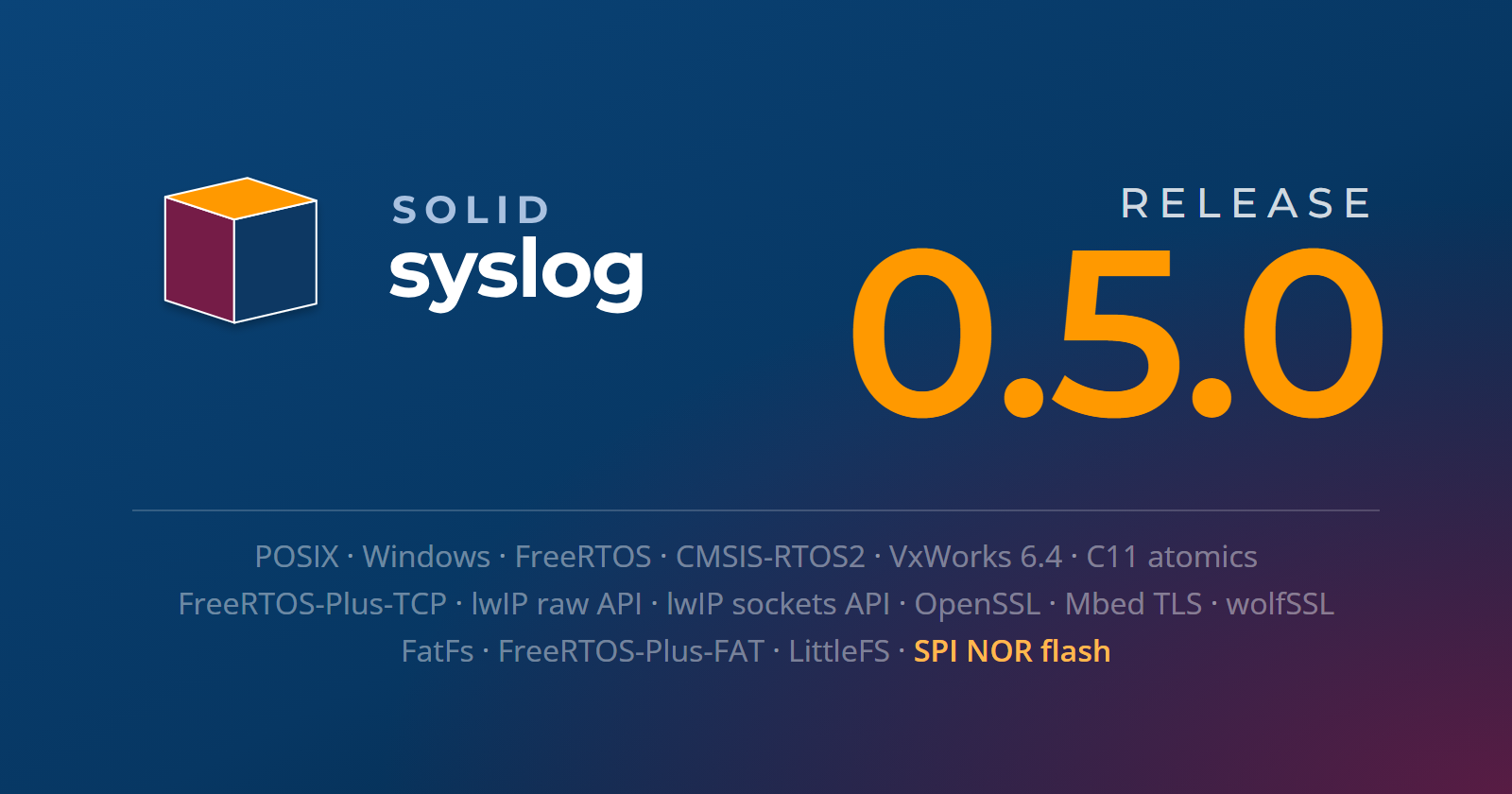
0.5.0 lets the store keep its records directly on NOR flash, with no filesystem beneath it, and adds an SPI NOR flash pack that learns the part from the part’s own parameter table. The logger now asks the device whether its user has opted out of security logging, a Cortex-M7 board joins the emulator as a quality gate, and coverage is now measured as MC/DC.
Store-and-forward is what keeps an audit trail through an outage: records wait on the device while the collector is unreachable and are sent when the link returns. Until now the store kept its blocks in files, so a device needed a filesystem to have one. Many small devices do not have a filesystem. They have a NOR flash part on an SPI bus, and nothing else that would justify one.
SolidSyslog 0.5.0 lets the store keep each of its blocks in one of the part’s own erase blocks, with nothing in between. The store takes the run of blocks the device gives it, uses them in rotation so that they wear evenly, and leaves the rest of the part to the product. Everything above the store is unchanged: the same at-rest policies, the same discard policy, the same reports into the trail when the medium fails.
What it costs the flash
We measured the two arrangements side by side on one part, a Winbond W25Q128JV on a Cortex-M7 board, with records of about 300 bytes stored and then sent:
| LittleFS | No filesystem | |
|---|---|---|
| A pace the store kept up with | 1 record every 260 ms | 1 record every 20 ms |
| Erases per record | 2.08 | 0.077, one for every 13 records |
| Programs per record | 11.6 | 2.2 |
| Reads per record | 105 | 9.5 |
Flash wears with each erase, so the second row is the one that decides how long a part lasts at a given rate of logging. The comparison page states how the figures were taken and what they do not show: it is one part, one board, one SPI rate and one size of record. It is also not the whole of the choice. A filesystem gives the product files of its own on the same part, and LittleFS brings wear levelling across everything on it. Both arrangements are supported, and the page is there so that an integrator free to choose has something to choose by.
An SPI NOR flash pack
The flash beneath the store is a role, as the file layer is, and 0.5.0 ships one filling of it. The SPI NOR flash pack drives a part over a bus the device supplies, and learns the part from its own SFDP table (JESD216), so it is not written for one maker’s parts. A part it cannot drive is refused when the flash is created, with the reason reported, and an erase or a program that outlasts its time limit fails and is reported rather than waited on. The pack needs C99 and no operating system. It brings the reference platforms to sixteen: POSIX, Windows, C11 atomics, OpenSSL, Mbed TLS, wolfSSL, lwIP raw and sockets APIs, FreeRTOS-Plus-TCP, FreeRTOS, CMSIS-RTOS2, VxWorks 6.4, FatFs, FreeRTOS-Plus-FAT, LittleFS and SPI NOR flash.
The user’s opt-out
The Cyber Resilience Act, Annex I Part I (2)(l), asks that security-relevant activity be recorded with an opt-out mechanism for the user. In 0.5.0 the logger asks the device whether capture is on, each time a record is logged, so the product’s own setting is the opt-out and the library honours it. The deactivation is itself recorded and delivered, with everything logged before it; records logged afterwards are dropped without disturbing the sequence numbers, so the collector sees a trail that stops where the user stopped it and not one with a gap.
A device often logs before it has read that setting. It can now answer undecided, and the logger holds those records in RAM, writing nothing to the store or the wire. If the answer turns out to be on, they are delivered; if it is off, they are discarded, and a device whose user had opted out leaves no trace of what it logged while finding that out. The CRA page gives the recipe.
A second, separate question is whether the device yet knows where its collector is. A device that receives the collector’s address from configuration arriving after its first events can say so, and the logger keeps those records in the store, attempting no delivery and raising no delivery failure, until the address is known.
A hardware gate alongside the emulator
The embedded targets run under QEMU on every change. An emulator checks behaviour, but it does not reproduce the timing of a real Ethernet MAC, an SPI bus or a flash part’s erase. 0.5.0 therefore adds a further quality gate on hardware: the same targets are run on ST’s NUCLEO-F767ZI, a Cortex-M7 board, to find the timing faults that emulation cannot show. FreeRTOS with lwIP and with FreeRTOS-Plus-TCP, and CMSIS-RTOS2 with lwIP, run over UDP and TCP on the board’s Ethernet, storing to a MicroSD card under FatFs and FreeRTOS-Plus-FAT, to LittleFS on NOR flash, and to NOR flash directly. On each, ten thousand records over UDP and ten thousand over TCP arrived once each and in order, and two thousand over each did so through the store. The testing page has the detail.
Coverage and upstreams
Code coverage is now measured as MC/DC, modified condition/decision coverage, and gated at 99 percent. The test report and coverage of every build are visible in the live documentation and packaged, signed, with the release. The release is tested against current upstreams: FreeRTOS V11.3.3, FreeRTOS-Plus-TCP V4.4.2, Mbed TLS 3.6.8, CMSIS 6.4, wolfSSL 5.9.4, FatFs R0.16, lwIP 2.2.1, LittleFS 2.11.3, and OpenSSL 3.5.9 and 3.6.5.
By our own assessment SolidSyslog continues to meet every applicable clause of RFC 5424, 5425, 5426 and 6587; the compliance matrix holds the evidence. No defect is open at this release.
Footprint
On the worked example, the first compliant record is about 7.1 KB of flash and 2.8 KB of RAM. The complete path, with pinned TLS, certificate renewal, mutual TLS, encryption at rest and the device’s own discard policy, is about 24.0 KB of flash and 38.1 KB of RAM, measured on the running target. That is within a hundred bytes of 0.4.0 on both counts. The hardening path states the cost of each stage.
Moving from 0.4.0
This is a 0.x release. The release notes list what to check under Before you upgrade. Both worked examples, CMake and GNU Make, have 0.5.0 releases rebuilt one commit per stage. The release carries a signed offline copy of its documentation, a signed software bill of materials and a signed source-tree hash.
Next
1.0.0 follows in Q4 2026. Any organisation can evaluate SolidSyslog free under the PolyForm Internal Use licence, with no time limit. Start from the product page or contact us about your product.